What a Virtual Doorman Does That an Empty Lobby Cannot
TLDR A virtual doorman screens visitors, manages access, handles deliveries, and responds to emergencies from a remote monitoring center. Every function a traditional lobby attendant performs at the desk, a virtual doorman performs through live cameras and two-way intercoms, with one difference: the virtual doorman covers every hour of every day at a fraction of the cost. A building without a doorman has an unguarded entrance. A building with a virtual doorman has a staffed one.
| Feature | No Doorman | Traditional Doorman | Virtual Doorman |
| Visitor screening | None | During shift hours only | 24/7 coverage |
| Package management | Unattended in the lobby | During shift hours only | Logged and tracked around the clock |
| Emergency response | The resident calls 911 alone | The doorman assists during the shift | Operator responds at any hour, dispatches immediately |
| Annual cost | $0 | $60,000 — $100,000+ | $3,600 — $12,000 |
| Coverage gaps | All hours | Nights, weekends, holidays | None |
A property manager in Queens ran a 90-unit apartment building with no doorman. The building had a buzzer system that connected to each unit’s phone. If a resident was home, they answered. If they were not home, nobody answered. Deliveries sat in the lobby. Visitors walked in behind residents who held the door open. A maintenance worker propped the front entrance at 7 a.m., and it stayed propped until someone noticed at noon.
In one year, the building logged 14 stolen packages, 3 unauthorized entries that resulted in unit break-ins, and a liability claim from a visitor who slipped in the lobby at 11 p.m. when nobody was present to address the wet floor. The total cost of those incidents exceeded $22,000.
The building could not afford a traditional doorman. At $60,000-$100,000 per year for a single full-time lobby attendant, the math did not work for a 90-unit property. But the math of having no doorman at all was costing $22,000 per year in losses and liabilities that a staffed entrance would have prevented.
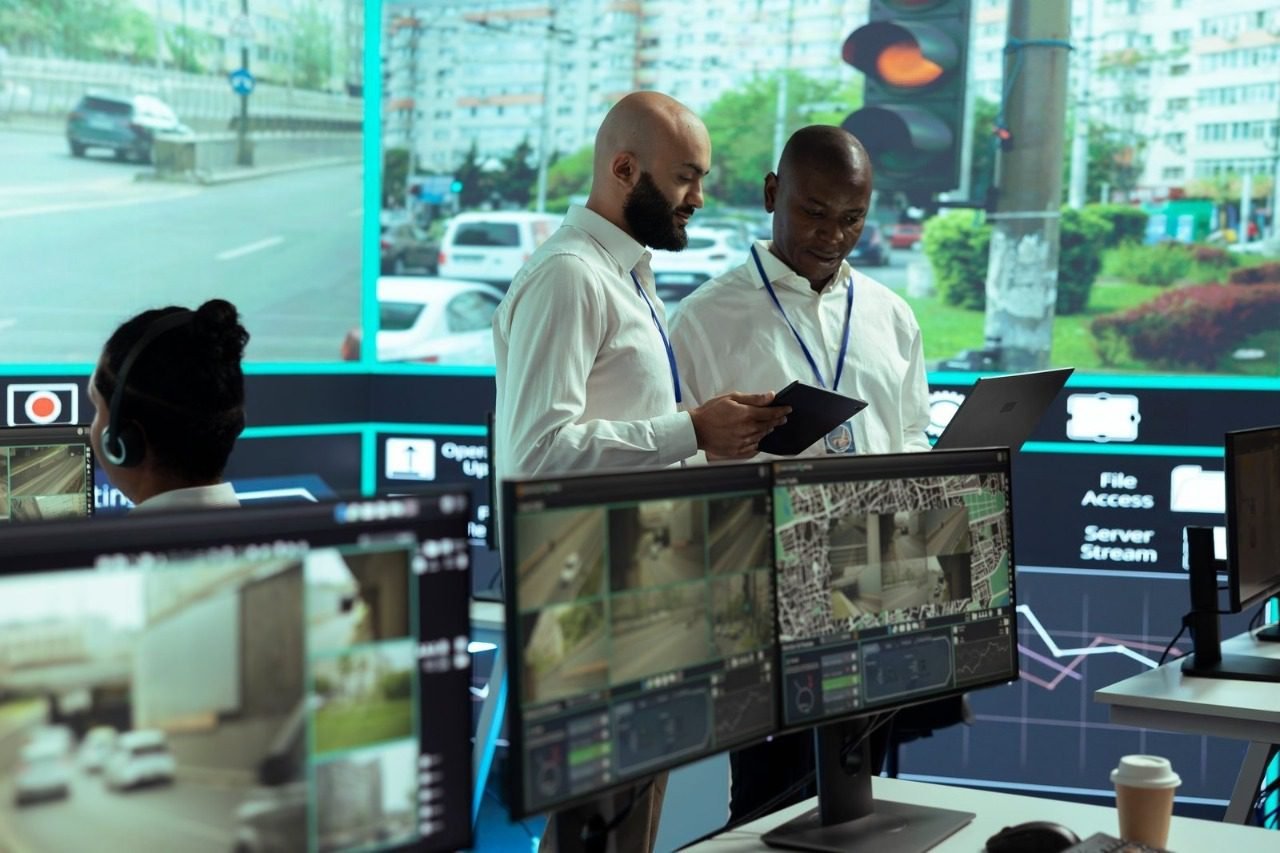
That is the gap a virtual doorman fills. Not a person standing at a desk. A trained operator watching the lobby screens manages access and responds to incidents from a monitoring center, covering every hour the building is open, at a cost the building can absorb.
What a Virtual Doorman Actually Does
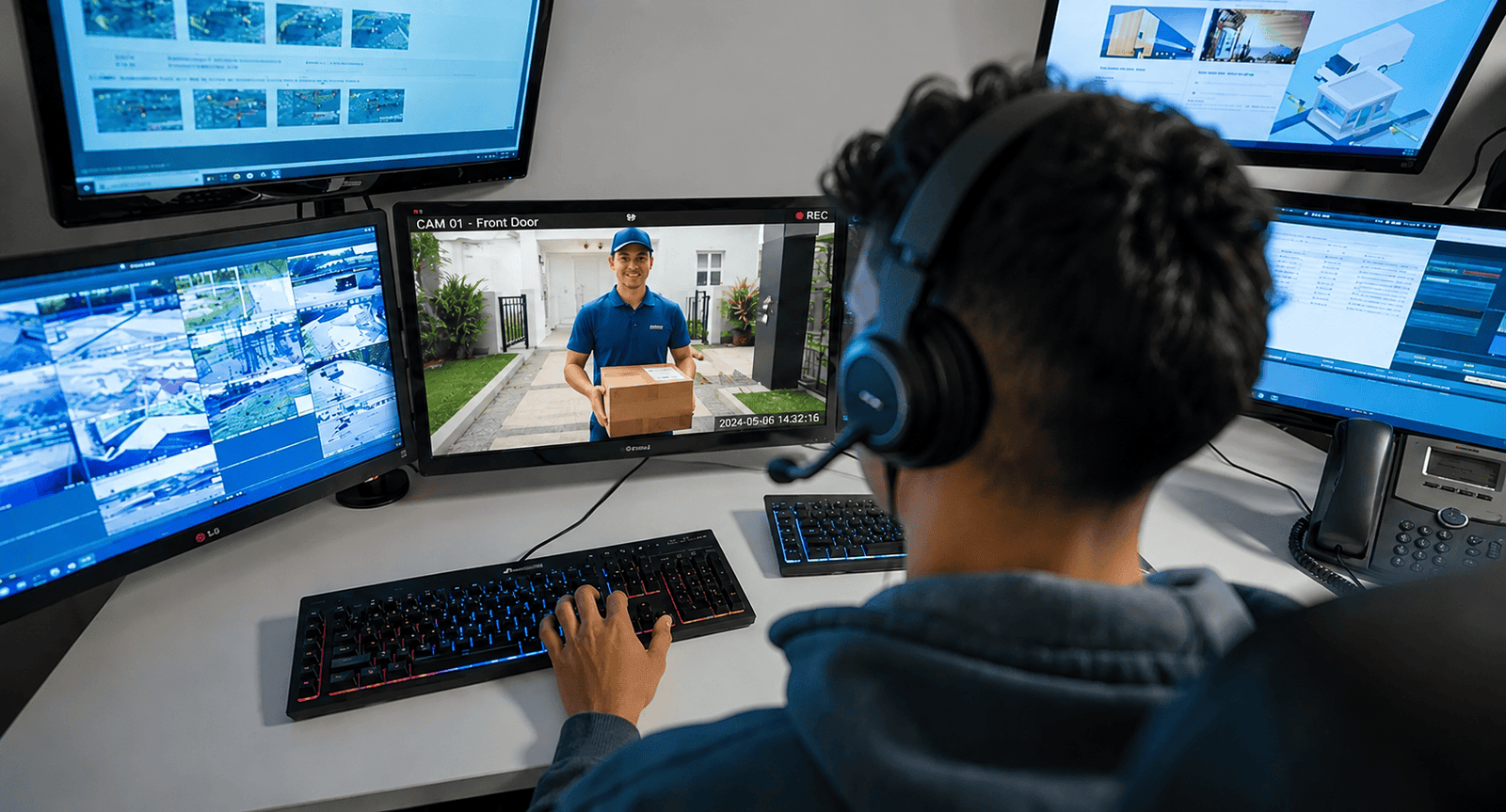
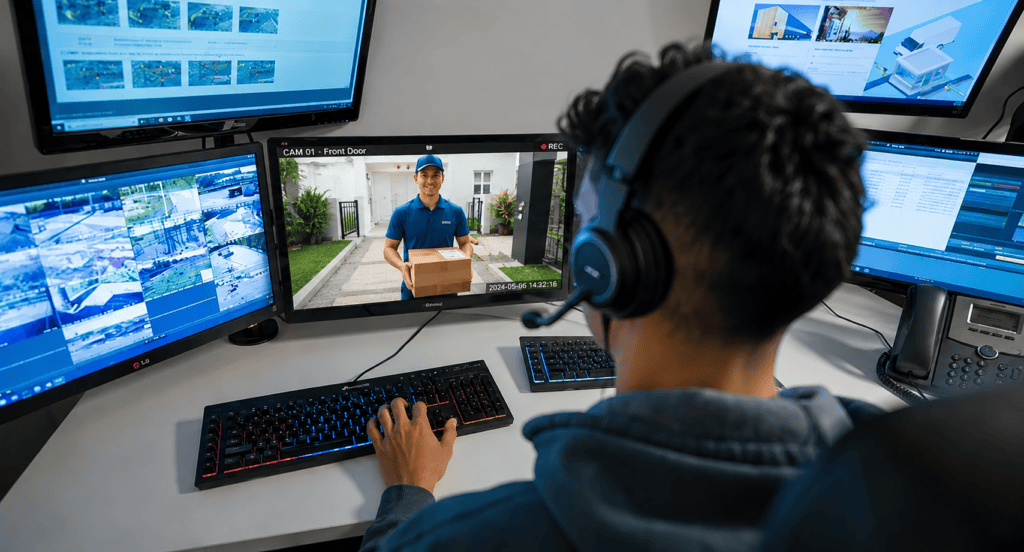
A virtual doorman is not a camera with a speaker. It is a trained operator sitting at a monitoring station, watching your building’s entrance through live video feeds, and communicating with visitors through a two-way intercom system.
When someone approaches the front door and presses the intercom button, the operator sees them on camera, speaks to them directly, and asks who they are visiting. The operator checks the resident directory, calls the resident to confirm, and either grants or denies access. The entire sequence takes less than 30 seconds. The visitor never stands at an unattended entrance wondering whether to walk in or walk away.
That is the core function. But the full scope of virtual doorman service extends well beyond visitor screening. The operator manages package deliveries by logging each one and notifying the resident. They monitor common area cameras for safety hazards, propped doors, and unauthorized access. They handle emergency situations by contacting building management, local authorities, or emergency services depending on the incident. They manage vendor and contractor access by verifying credentials and tracking entry and exit times.
A detailed breakdown of how a virtual doorman works step by step shows the full technology stack: lobby cameras, intercom systems, electronic locks, and a centralized monitoring platform that ties everything together. The hardware sits in the building. The operator sits at the monitoring center. The resident sees the same result as a traditional doorman without the $60,000 salary attached to it.
The Seven Specific Benefits of a Virtual Doorman
Visitor Screening That Covers Every Hour
A traditional doorman screens visitors during their shift. A virtual doorman screens visitors 24 hours a day, 7 days a week, including nights, weekends, and holidays. The coverage does not depend on one person showing up for work. It depends on a monitoring center that is always staffed.
The digital doorman model is built around this continuous coverage. A building that has a traditional doorman from 8 a.m. to 6 p.m. has an unguarded entrance for the remaining 14 hours. A virtual doorman covers all 24.
Access Control Without Physical Keys
A virtual doorman system integrates with electronic locks and remote access control to grant or deny entry without a physical key exchange. The operator unlocks the door remotely after confirming the visitor’s identity. No keys get lost. No fobs get copied. No propped doors go unnoticed because the operator sees the entrance camera at all times.
When a resident locks themselves out at 2 a.m., the operator verifies their identity through the intercom and camera, then grants access. No locksmith call. No waiting in the hallway. No cost to the resident or the building.
Package Management That Eliminates Theft
Package theft in apartment buildings is not a break-in problem. It is a lobby problem. Deliveries sit unattended in common areas for hours. Residents grab boxes that are not theirs. Strangers follow delivery drivers into the building and help themselves.
A virtual doorman logs every package delivered. The operator watches the delivery happen on camera, records the timestamp, and notifies the resident. If someone other than the resident picks up a package, the operator sees it and flags it immediately. The seven ways a virtual doorman improves building security include package tracking as one of the highest-impact functions for residential properties.
Emergency Response at Any Hour
When a medical emergency, fire, or security incident happens at 3 a.m. in a building with no doorman, the resident calls 911 alone. Nobody in the building knows what is happening. Nobody guides the paramedics to the correct unit. Nobody holds the elevator or opens the service entrance.
A virtual doorman operator handles emergency coordination in real time. They contact emergency services, unlock the entrance for first responders, guide them to the correct unit through the intercom, and notify building management simultaneously. The response is coordinated instead of chaotic.
Cost That Fits Buildings of Any Size
A traditional full-time doorman costs $60,000-$100,000 per year in salary, benefits, payroll taxes, and replacement coverage for sick days, vacations, and holidays. A second shift doubles that. Full 24/7 coverage with three rotating doormen costs $180,000-$300,000 per year.
A virtual doorman service covers all 24 hours for $3,600-$12,000 per year, depending on the building size and the level of service. That is 5-10% of the cost of a single traditional doorman, with coverage that extends across every hour a traditional doorman does not cover.
The cost comparison between a virtual doorman and traditional security breaks down these numbers in detail. For buildings that cannot afford a traditional doorman, a virtual doorman is not a downgrade. It is the only way to have a staffed entrance at all.
Property Value and Resident Retention
Buildings with doorman service, whether virtual or traditional, command higher rents and higher resale values than buildings without. Residents stay longer in buildings where they feel safe and where daily inconveniences like package management and visitor access are handled for them.
A virtual doorman for apartments adds a service layer that directly impacts resident satisfaction. The resident does not care whether the doorman is in the lobby or at a monitoring center. They care that their packages are tracked, their visitors are screened, and their building entrance is not an open door.
Liability Protection for Property Managers
An unattended lobby is a liability. A slip and fall with no witness and no response is a lawsuit. An unauthorized entry that leads to a unit break-in is a negligence claim. A delivery driver who is injured in a common area with no staff present creates exposure for the property management company.
A virtual doorman creates a documented record of every incident. Camera footage, operator logs, and timestamped actions provide the evidence trail that protects the building and the management company. When an insurer or attorney asks what the building did to prevent the incident, the monitoring logs answer the question.
The Honest Counter-Argument: Physical Presence vs. Remote Coverage
A traditional doorman provides a human presence that residents value. A familiar face in the lobby. A person who knows the residents by name. A physical deterrent standing between the entrance and anyone who walks through it.
That value is real. This article does not dismiss it.
But that value exists only during the hours the doorman is on shift. A doorman who works 8 a.m. to 6 p.m. provides presence for 10 hours and absence for 14. The building is unguarded for more hours than it is guarded. The pros and cons of virtual doorman service address this trade-off directly.
For buildings that can afford full-time traditional doorman coverage, a virtual doorman can fill the overnight, weekend, and holiday gaps that the traditional doorman does not cover. For buildings that cannot afford a traditional doorman at all, a virtual doorman provides coverage where none currently exists.
The virtual doorman model in NYC shows how buildings in one of the most doorman-dense cities in the world are adopting virtual services to cover the hours and the buildings that traditional staffing cannot reach.
How to Choose the Right Virtual Doorman Provider
Not every virtual doorman service delivers the same coverage. The difference between providers comes down to three factors: operator quality, response time, and system integration.
Operator quality means trained professionals who can handle visitor screening, emergency escalation, and resident communication with professionalism. Response time means the intercom is answered within seconds, not minutes. System integration means the virtual doorman platform connects to your building’s existing cameras, intercoms, and electronic locks without requiring a full hardware replacement.
A complete guide to choosing virtual doorman services covers the evaluation criteria in detail. The short version: ask how fast the intercom is answered, ask who trains the operators, and ask whether the system works with your existing hardware.
Why GCCTVMS Virtual Doorman Service Covers What an Empty Lobby Cannot
GCCTVMS provides virtual doorman monitoring with trained operators watching your building’s entrance, lobby, and common areas 24 hours a day. When a visitor presses the intercom, our operator answers within seconds, screens the visitor, confirms with the resident, and grants or denies access.
We handle package logging, vendor access management, emergency coordination, and incident documentation as part of the service. Every action is timestamped and logged. Every camera feed is watched. Every hour is covered.
Our virtual doorman service works with existing intercom systems, electronic locks, and camera setups. The hardware you already have in your building connects to our monitoring center without a full system replacement. If your building needs additional cameras or an intercom upgrade, we advise on exactly what is needed and nothing more.
GCCTVMS operates virtual doorman services across the USA, UK, Singapore, and Pakistan. Whether you manage a 30-unit walkup or a 200-unit high-rise, the coverage model scales to fit your building and your budget.
Your lobby is either staffed or it is not. A virtual doorman makes it staffed.
Book a free 30-minute call and we will walk through your building’s layout, access points, and current setup to show you what virtual doorman coverage looks like for your property.
Key Takeaways
- A virtual doorman performs every function a traditional doorman performs, including visitor screening, package management, access control, and emergency response, from a remote monitoring center through live cameras and two-way intercoms.
- Virtual doorman service covers all 24 hours for $3,600-$12,000 per year. A traditional full-time doorman costs $60,000-$100,000 for a single shift.
- Buildings with no doorman average higher package theft, unauthorized entries, and liability exposure than buildings with any form of doorman coverage.
- The honest trade-off is physical presence vs. continuous coverage. A virtual doorman does not replace the familiar face in the lobby, but it does replace the 14 hours per day when no one is there at all.
- Virtual doorman systems integrate with existing building hardware, which means the upgrade is the monitoring layer, not a full system replacement.
FAQs
What is a virtual doorman?
A virtual doorman is a trained operator who monitors a building’s entrance through live camera feeds and communicates with visitors through a two-way intercom system. The operator screens visitors, manages package deliveries, controls access, and handles emergencies from a remote monitoring center, providing the same functions as a traditional lobby attendant without being physically present.
How much does a virtual doorman cost compared to a traditional doorman?
A virtual doorman service costs $3,600-$12,000 per year, depending on building size and service level. A traditional full-time doorman costs $60,000-$100,000 per year for a single shift. Full 24/7 traditional coverage with three rotating doormen costs $180,000-$300,000 per year. A virtual doorman covers all 24 hours at 5-10% of the traditional cost.
Can a virtual doorman work with my building’s existing intercom and cameras?
Yes. Most virtual doorman systems integrate with existing intercom hardware, electronic locks, and camera setups. The monitoring center connects to your current equipment remotely. If upgrades are needed, they are typically limited to adding a camera at the entrance or updating the intercom, not replacing the entire system.
Does a virtual doorman handle emergencies?
Yes. When a medical emergency, fire, or security incident occurs, the virtual doorman operator contacts emergency services, unlocks the entrance for first responders, guides them to the correct unit, and notifies building management. The response is coordinated in real time regardless of the hour.
Is a virtual doorman as effective as a physical doorman?
A virtual doorman performs the same screening, access control, and emergency response functions as a physical doorman. The trade-off is physical presence: a traditional doorman offers a familiar face in the lobby, while a virtual doorman offers continuous coverage across all 24 hours. For buildings that cannot afford a traditional doorman, a virtual doorman provides staffed coverage where none would otherwise exist.